HLS vs DASH: How the Two Streaming Formats Differ
HLS and MPEG-DASH both stream video in short segments with adaptive quality. Here is how they differ in playlists, codecs, devices and DRM, and what an MPD file is.

Sommaire
01The short answer02Side-by-side comparison03How each format describes a stream04What is an MPD file?05CMAF: where the two meet06Which one should you use?07Playing HLS and DASH in your browserAlmost every video you stream today arrives through one of two formats: HLS or MPEG-DASH. Both chop video into short segments and let the player change quality as your connection changes. They differ in who made them, how they describe the stream and where they work best.
The short answer
- HLS (HTTP Live Streaming) was created by Apple. It describes streams with M3U8 playlists and works on virtually every device, including all Apple products.
- DASH (Dynamic Adaptive Streaming over HTTP) is an international standard (ISO/IEC 23009-1). It describes streams with an MPD manifest, an XML file, and is codec-agnostic.
For viewers, both give the same experience: video that starts fast and adapts to your bandwidth. For publishers, the choice depends on devices, codecs and DRM.
Side-by-side comparison
| HLS | MPEG-DASH | |
|---|---|---|
| Created by | Apple | MPEG (international standard) |
| Manifest | .m3u8 text playlists |
.mpd XML manifest |
| Segments | .ts or fragmented MP4 (.m4s) |
Fragmented MP4 (.m4s) or WebM |
| Codecs | H.264, HEVC, AAC, more in newer versions | Any codec, including AV1 and VP9 |
| Apple devices | Native everywhere | Needs a player library; not native on iPhone |
| Browsers | Native in Safari; through a player elsewhere | Through a player library |
| DRM | FairPlay, and others with CMAF | Widevine, PlayReady through Common Encryption |
| Low latency | Low-Latency HLS | Low-Latency DASH |
How each format describes a stream
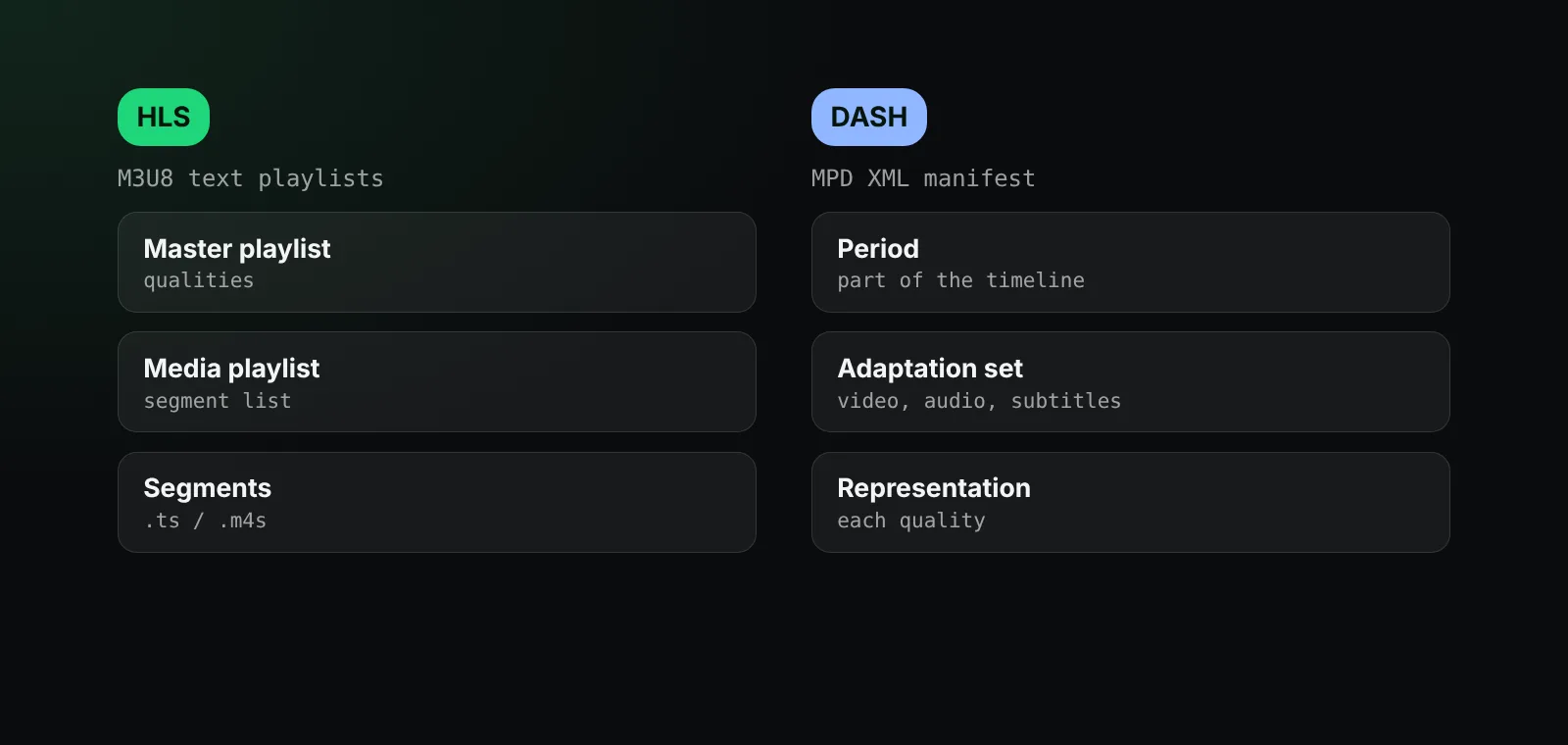
HLS uses two levels of M3U8 playlists: a master playlist lists the qualities, and a media playlist for each quality lists the segments. It is plain text and easy to read. We explain it line by line in what is M3U8.
DASH uses a single MPD file in XML. It is organised into Periods (parts of the timeline), Adaptation Sets (for example video, audio in English, audio in Spanish, subtitles) and Representations (the qualities). One MPD can describe a whole programme with all its tracks.
<MPD type="static" mediaPresentationDuration="PT58M12S">
  <Period>
    <AdaptationSet mimeType="video/mp4">
      <Representation id="720p" bandwidth="2800000" width="1280" height="720"/>
      <Representation id="1080p" bandwidth="5000000" width="1920" height="1080"/>
    </AdaptationSet>
    <AdaptationSet mimeType="audio/mp4" lang="en"/>
  </Period>
</MPD>
What is an MPD file?
An MPD (Media Presentation Description) file is the manifest of a DASH stream. Like an M3U8 file, it contains no video, only the description of where the segments are. An "MPD player" or "DASH player" is any player that can read this manifest.
CMAF: where the two meet
Since 2018 the industry has been moving to CMAF, a shared segment format based on fragmented MP4. With CMAF, a publisher stores the video once and serves it with both an M3U8 playlist and an MPD manifest. That is why many publishers now offer both formats for the same video.
Which one should you use?
- Publishing to the widest set of devices, especially iPhones, iPads and Macs: HLS, or CMAF with both manifests.
- Using newer codecs such as AV1, or Widevine and PlayReady DRM: DASH is common.
- Watching: you do not need to choose. A capable player handles both.
Playing HLS and DASH in your browser
Desktop browsers other than Safari cannot open M3U8 or MPD addresses directly. The free BetterStream extension plays both in Chrome, Edge, Brave and Opera: paste the address in Plugins, Add plugin, and press play. It switches quality automatically, lets you pick audio tracks and subtitles, and remembers where you stopped. Streams locked to a specific service with DRM will usually play only in that service's own app.
Frequently asked questions
Is DASH better than HLS?
Neither is better overall. DASH is more flexible with codecs; HLS has wider native support on Apple devices.
Can a browser play an MPD file?
Not by itself. It needs a player that reads DASH, such as the BetterStream extension or a website's own player.
Do big streaming services use HLS or DASH?
Large services use both, choosing per device. Their streams are protected with DRM and are meant for their own apps.
What does adaptive bitrate mean?
The stream is available in several qualities, and the player switches between them as your connection speeds up or slows down.
Questions about a specific stream? Ask in the help center or read the M3U player guide.